“Ophelia’s Death” Installment Two by Presley Nassise. Interview with model Maddie Natoli

Presley 2

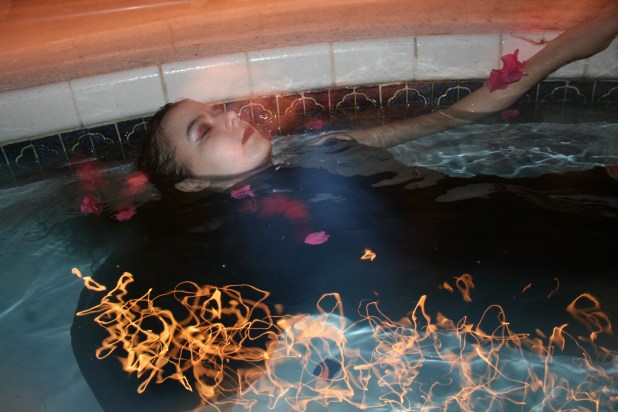
[Image Description] Ophelia wears a dark dress. She has pale skin, dark hair and painted lips. She floats in a pool of blue water, her hands near her face, the finger tips and face left uncovered by the water. Her eyes are closed. Pink flower petals float around her. A red stain is in the water near her body. ]

Interview with Maddie Natoli, model featured in both “Ophelia’s Death” pictures.

TLM: What was the inspiration for these photographs?
MN: I have always wanted to do an Ophelia themed photo shoot actually. She has always been one of my favorite Shakespearean characters, and in my opinion Gertrude’s monologue on how she died is one of my favorite Shakespearean pieces. He eloquently captured her death in a way that addressed her beauty, but [also] the tragic nature that was her death. I asked Presley if she would do the shoot, because I was familiar with her love for photography, but I also knew she would be able to appreciate and enjoy doing the shoot because she is as big of a Shakespeare fan as I am.
TLM: What are you trying to change about diversity or representation through creating these images?
MN: I would love to be able to say I witnessed the acceptance of ‘unconventional’ models be referred to [as] just models. Creating and encouraging projects that are inclusive will help show the world that there’s nothing wrong with being disabled, heavier set, being a part of the LGBTQ+ community, or the POC community. Casting unconventional people in traditional roles helps us break down social barriers. A recent and widely popular example of this would be Lin Manuel Miranda’s “Hamilton”. Representation matters, and at the end of the day, all anyone wants to know is that their presence on this Earth matters, and when you can’t find characters that you relate to, or that look like you, it can be very hurtful to younger audiences. I want people to see themselves in these characters and in our project.
TLM: Why do you feel these aspects of representation need to be challenged or changed?
MN: Representation hasn’t really changed much, until this last decade, about. We need to, as a society, need to become more conscious of how repetitive our media, our blockbuster movies, and our New York Times best selling lists have become. It’s boring to see the same stories over and over again. We need new faces, we need to allow POC and LGBTQ artists tell their stories. We need to see the way they deal with their struggles and how they celebrate their triumphs.
TLM: What about this Shakespeare character did you find inspirational?
MN: I find Ophelia to be a very strong character who had to deal with the loss of not only her father, but of the man she loved. She watched Hamlet slowly descend into madness, and then the effect of that madness took her beloved father from her, which in turn, cemented the decision that she take her own life. Nothing about suicide is romantic, and despite the act being the central part of our piece, neither Presley or I wanted to portray her suicide in a light that was seen as romantic, but as a depressed character who made the irreversible decision.
TLM: What place do you think this character has in today’s media?
MN: We have seen many different characterizations of characters who are mentally ill or who have taken their own life pop up in the last couple of years, but none of the characters have been properly portrayed, in my opinion. I hope people look at our Ophelia and understand that she stands for people who have dealt with hardships, that she stands for all those struggling with illnesses, whether they are mental or physical, and last but not least, that she stands for those we’ve lost to suicide.
TLM: Where can readers learn more about your work?
MN: Readers can go check Presley and I out on our Instagrams, @mimzee_madz_photography and @presleynasissephotography. To follow the project as a whole, the Instagram @shakespearephotoproject is where we keep all of our sets. To be a part of the project, you can private message us on Instagram, or email us at shakespearephotoproject@gmail.com.

Two Photographs from “Memories” By David Rodriguez

Memory 6 [Image Description: in this black and white photo a couple is on a beach, the water behind them. The woman wears a sun hat and white dress with lace trim. She has shoulder length straight dark hair and has a pensive look on her face. A man faces her. He wears a dark shirt, white shorts, and has dark hair. His figure is disappearing, like steam rising into the air.]

memory6


ARTIST STATEMENT

I like to photograph people, I feel very comfortable doing portraits, but I always try to go a little further. That is the reason why I try to look for risky compositions, with a touch of surrealism. Works like those of Man Ray, Erwin Blumenfeld or Guy Bourdin inspire me immensely.

Each person inspires in me a different sensation, so before I do the shooting, I imagine how I would like to portray him or her. Then, I create a concept and imagine a story. I do not like to get attached to reality. Instead, I like to transform it, challenging the model with unusual situations. I play with the model, making each session a culture encounter, but also an enriching and surprising experience for both of us. The use of the photography techniques I use, whether high speed, long exposure or others, is determined by the conceptual preconception I had in mind.

Memory 4 [Image Description: The same man and woman in the first photo face one another. She wears a sun hat over her shoulder length dark hair and white top with lace trim. We only see her top half, her image is blurred, as if she might float away from sight. The man faces her, his dark shape cut up with white lines. He is also fading away and is blurred.]

memory4

About the Photographer: My name is David Rodríguez. I am 39 years old and I am from Spain. From an early age, I have always been attracted to the art world, but my love for photography didn´t start until 2013, the year I bought my first reflex camera, and I began to explore my attraction to art.

“Signs” by Hank Trout

“Signs” by Hank Trout

The damned STOP TRUMP sign simply refused to remain on the long flat stick no matter how many staples Alex pounded into it. The sign pretended to be firmly attached to the stick, but every time Alex picked it up to add it to the growing stack of similar signs, it drooped forward from the top and pulled out every one of the staples. On his fourth attempt at affixing the sign to the stick, Alex slammed the damned thing down on the table, quickly lined up the sign on top of it, opened the Swingline 747 stapler, positioned the arm of the stapler on the sign, and using his clenched fist as a hammer, pounded another dozen staples into the sign. And again, like wallpaper curling away from a wall, the sign rolled forward and pulled out all the staples.

“You’re new at this, aren’t you?”

Alex turned quickly to meet the voice behind him.

“Here, let me help you.” Alex found himself face-to-chest with Michael, a tenor-voiced salt-and-pepper bearded man who was, and looked to be, just on the other side of fifty, fifty-two actually, who smiled down at Alex’s rather befuddled expression. “You’re using the wrong kind of stapler, for starters,” he said, raising a heavy-duty industrial-strength stapler between them. “Let me show you.” Still looking up into Michael’s face, Alex stepped aside.

He watched as Michael positioned the stick and the sign on the base of the stapler and pressed down on the stapler’s arm, driving a long staple through both and into slots that curled the staple’s points back up into the stick, securing the sign firmly in place. He slid the stick and sign eight inches down the base of the stapler and stapled again. He turned the sign over, face down, and positioned a second sign on top. Repeating the process, he secured the second sign.

“There.” Michael announced. “That’ll hold it even if it gets windy out there tonight. Now, you can use your stapler and hit all four corners so the two sides of the sign don’t flop apart.” Alex stapled each corner as instructed, then picked up the protest sign, pumped it above his head a few times, with a big grin across his face, and then tossed the sign on top of the pile.

“The other reason we fix two signs together,” Michael continued, “is for the photos. There are going to be busloads of photographers at this rally, and they’re going to be all around – in front of us, to the sides, behind us. We don’t want them photographing empty backsides of our posters! Blank white poster board makes us look like we don’t know what we’re doing.”

“Thanks, man, I would have been here all night trying to put these signs together.”

Michael laid his hand on the young man’s shoulder. “Nah, trust me, someone would have noticed the lack of signs piling up and would have come to check up on you! I just got here first with the right stapler. You didn’t answer my question — new at this?”

“At using a stapler?” They both laughed.

“No, no, I mean this,” Michael said, sweeping his arm around in an arc that embraced all of the work tables set up in this large room of the Women’s Building, “this rally-and-protest prep. Are you new at all of this?”

“Yeah, I am, I guess – well, no, wait – I mean, my mama used to take me with her when she went on La Raza protests, but I was really young then. This is the first time I’ve actually participated in a protest by myself, worked on the preparations.” Alex’s shyness was overtaken by pride when he thought of his mother and remembered why he was working on this protest.

“You look like you’re still pretty young,” Michael said, as he prepared another sign and stick, then indicated with a nod that Alex should staple them.

Alex positioned the stapler’s base under the stick and pumped the arm downward, hard, securing the first staple.

“I never know what to say to people when they say things like that to me,” Alex looked at Michael quizzically. “I mean, am I being complimented, or told that I don’t fit in? Am I supposed to thank someone for pointing out something that’s pretty much out of my control?” He pounded the second staple into place and then flipped the sign over and covered it with another one. He looked up at Michael, who seemed perplexed by Alex’s reaction. “Sorry, look, I’m 24 and I know I look like I should still be in high school and trust me it’s not a lot of fun.” The third staple put an exclamation point on his utterance. He brushed away the dark curly hair that hung over his forehead and smiled. “But I’m used to it. Most of the time. I’m just really kinda touchy right now.” The fourth staple went in more quietly, less angrily, but firmly.

Michael hesitated for a moment, not sure, after this young guy’s outburst, whether he really wanted to engage him in conversation. Or an attempt at one. Then decided —

“I think we’re all kind of touchy these days, don’t worry about it.” He smiled and extended his hand. “My name’s Michael, by the way.”

“Alex. Actually, it’s Alejandro, but everyone calls me Alex, it’s easier.”

“’Easier’? For them or for you? What’s so difficult about a beautiful name like Alejandro?” The handshake lasted several seconds, with laser-like eye contact. Michael smiled again. Nodding toward the signs and sticks on the table, he said, “Well, Alejandro, it looks like you’ve got work to do here. I’ll be running around, making sure everyone has what they need, so if you need anything just give a yell.”

“Thanks, Michael, I’ll come find you if I need anything.”

“I certainly hope so,” Michael said, briefly eyeing Alejandro up and down. “Any time.” He walked off to another table at the opposite end of the large auditorium, glancing back twice, and smiling, catching Alejandro watching him.


Later that night, relishing the gloriously warm moonlit San Francisco evening, a crowd of thousands marched in unity – LGBTQ folks, young women, undocumented immigrants, elderly straight folks, young trans kids, African Americans, Latinos – all the marginalized people who face threats from the Trump administration. From the Cable Car turnaround at Powell Street, up Market Street through the Castro to the Mission District, they marched and chanted. They held each other, they commiserated, they cried and laughed, they pledged to support each other and to work together against the forces of racism and bigotry that seemed to have taken over their country. They pledged solidarity.

The night was entirely peaceful – not one violent incident, not one arrest. It was a diverse, dedicated, inspired, shell-shocked but determined group of people. And right at the front of the thousands, his angry tenor rising loudly into the warm clear night air, marched Michael. “Act Up!” he yelled with others at the front of the march, and the crowd behind them responded, “Fight Back!”

“Act Up!”

“Fight Back!”

As he marched at the front of the crowd and chanted, Michael thought he heard a familiar voice behind him in the “Fight Back!” chorus. He turned and walked backwards briefly to look over the crowd behind him. Sure enough, some fifteen or twenty feet behind him marched Alejandro, hoisting his double-sided sign held high, yelling his full-throated “Fight Back!” response like a man marshaling the will to fight.

Michael smiled when he saw Alejandro, caught his eye, and waved for him to push through the crowd and join him at the front.

“Alejandro! I’m glad to see you!” Michael gave Alejandro a quick hug-while-walking and continued, “You did a terrific job with the signs. Just look around you.”

Alejandro looked around, and indeed, he saw many signs he had stapled together earlier at the Women’s Building. He looked up at Michael and grinned, his deep brown eyes twinkling, his pride glowing. “Yeah, thanks to you, they look great!” Alejandro looked over the crowd as they marched along, chanting, and his eyes began to well up with tears. “I just wish my mama could be here to see this.”

Michael put his left arm around Alejandro’s shoulders and drew him close. “You mean, to see you, don’t you?”

Alejandro wiped his eyes with the back of his hand. He looked up into Michael’s light blue eyes. “Yeah, you’re right, I wish she could be here with us, to see me here. I know she’s proud of me – she knows I’m here tonight – but she can’t come out to march with us. I wish she was here – she’d be yelling loud enough to drown out all of us!” Without thinking about it, Alejandro slipped his right arm around Michael’s waist.

“Where is your mother? Why can’t she be here?” Michael asked.

“She’s afraid,” Alejandro answered. “No papers. She came here twenty-five, twenty-six years ago from Guatemala. Things were fine until recently. She’s been really active in the Mission with La Raza and La Casa de las Madres for many years. But now, since the election, she’s been scared. She’s afraid to leave the apartment; she goes to the grocery store and to church and that’s it. She’s afraid to go out in public for very long, afraid that ICE will grab her off Mission Street someday.” He looked up at Michael again, gave him a half-smile. “I’ll be okay. I’m legal – I was born here, at SF General. But mama….” He looked back down at the pavement beneath them, then turned his face away from Michael.

Michael squeezed Alejandro’s shoulders tighter against him. “Hey!” When Alejandro looked back at Michael, the concern and, yes, the love he saw in Michael’s face was almost too much. The tears flowed freely down Alejandro’s cheeks now. “You’re going to be fine and your mama isn’t going anywhere! I promise. This is a sanctuary city and we’re going to stay a sanctuary city no matter what the orange fascist says or does!”

“I hope you’re right.” Alejandro wiped his face, snaked his arm around Michael’s waist again, holding tighter this time.

“Stick with me, Kid! We got this!” Michael bent slightly and kissed Alejandro on the forehead. He hesitated a moment, then pulled Alejandro in tighter and kissed him on the mouth.

Leaning back from Alejandro, surprised at himself, Michael said, “I shouldn’t have done that. I’m sorry.” He regretted having let his emotion overwhelm his better sense. Kissing a kid like that! What was he thinking?

“Why?” Alejandro looked truly perplexed. “I’m glad you kissed me. I’ve wanted you to. I want you to kiss me again.”

Michael looked down warily at Alejandro. He had to admit, his arm around Alejandro’s shoulders and Alejandro’s arm around his waist felt really good, felt right. Still… he knew he was more than twice Alejandro’s age. The way some people sometimes imagine their lives as scenes from a movie or lyrics to a song, Michael, the writer, often imagined his life in terms of the headlines he might generate – Local Writer, Advocate Wins Pulitzer Prize for Insightful Criticism – or – Veteran Queer Activist Inspires Thousands at Anti-Trump Rally. But in the brief moment he imagined himself and Alejandro together in some way, the headline he envisioned was, Old White Queer Robs Cradle, Steals Young Guatemalan from His Mama.

“We’ll see,” Michael said, trying to smile down on Alejandro. He went back to yelling “Act Up!” and waiting for Alejandro’s and the crowd’s “Fight Back!”


“That was fun!” Alejandro drained what was left of his Corona and leaned back against the bench on El Rio’s patio. The rally had proceeded down 18th Street from the Castro into the heart of the Mission District. The speeches were wildly cheered, and then the crowd dispersed into the warm night. Alejandro had practically dragged Michael up the street to El Rio for a beer.

“That was exhausting!” Michael corrected him. He tilted his beer toward Alejandro in a kind of salute. Alejandro laid his hand on Michael’s thigh.

“But aren’t you excited?! What a great night!” Michael smiled at Alejandro’s enthusiasm.

“Y’know, Alejandro,” Michael began, laying his hand atop Alejandro’s, “I’ve been rallying and marching through the Castro and the Mission for more than thirty years, starting in the early Eighties – years before you were even born! And yes, this was a great rally and march – you gotta love the diversity and the dedication of all these people who showed up. But sometimes I wonder why we bother.”

Alejandro was having none of it. “Whattya mean, ‘why we bother’? We have to protest! We have to show up and be counted and stand up to these bastardos! We have to!”

Michael sighed, collected his thoughts for a moment or two. He explained, slowly.

“What I mean is, thirty-five years ago, I marched down Castro demanding money for AIDS research. Thirty years ago, I marched down Castro demanding money to make medications available. I’ve marched through the Castro and the Mission demanding ‘gay liberation,’ demanding the right to marry, demanding an end to racial discrimination, demanding an end to deportations, demanding the decriminalization of HIV, demanding affordable housing for long-term AIDS survivors,… And as we were out there this evening, it hit me – here we are again, fighting the same damned fights we’ve fought hundreds of times over the last thirty, thirty-five years, fighting the same bigots and short-sighted politicians, fighting the same stupidity.” He gave Alejandro a weary smile. “I guess I’m just tired of fighting.”

Alejandro listened intently, watching Michael’s eyes as he seemed to recall each protest he had marched in over the decades. He slid his arm around Michael’s shoulders and pulled the older man toward him. He kissed Michael on the cheek just above his beard line. He leaned back just a bit so he could look Michael directly in the eye. “That’s why you need me! I’m not tired, I’m ready to fight, and I need you to show me how. All of us young folks out there tonight, we all need you. Hell, I couldn’t even staple a sign onto a damn stick without your help! But together? Damn! We would make a great tag-team!”

Michael was tempted to let himself get swept up in Alejandro’s enthusiasm. He gave Alejandro’s thigh a squeeze. “A great tag-team, eh? What makes you think so? You realize, of course, that I’m more than twice your age!”

“Yes, I know that – it just means that you’ve probably done twice as much and learned twice as much. I can learn so much from you – and not just about rallies and protests!” Alejandro’s eagerness was downright palpable. Without labeling or questioning it, he was falling in love with this older man, this veteran street warrior. He wanted desperately what Michael could give him, could teach him. His hand cupped the back of Michael’s neck and drew him in for a long, hungry kiss. They parted; Alejandro continued fondling Michael’s beard; Michael put his hand on top of Alejandro’s.

“I don’t know, Alejandro… Do you think I can keep up with you?”

“Hmmm, I dunno…” teased Alejandro. “You’ll just have to take me home and find out!” He kissed Michael again, then stood up, gave him his hand, and pulled him to his feet. They walked out of El Rio and into the warm Mission night, hand in hand.


About the author: 

Hank Trout is a 64-year-old HIV+ gay writer and activist. In the early 1980s, he edited DrummerMalebox, and Folsom Magazines; currently, he is an Editor-at-Large for A&U: America’s AIDS Magazine. A long-term HIV/AIDS survivor (diagnosed in 1989), Hank lives in San Francisco, California with his fiance Rick Greathouse.


A Photograph by SEIGAR from “Tales of a City”

From “Tales of a City” by SEIGAR


Cuentos de una ciudad II (72)

Image Description: [A man and woman with graying hair stand in front of Van Gogh’s painting “Sunflowers”, large yellow flowers with green leaves in a yellow vase, placed on a yellow table are visible. We can only see the backs of the couple, the man wears a grey sweater and blue jeans. He has short hair. The woman has shoulder length hair and wears a black velvet coat and blue jeans, the top of her black boot is visible. The woman has only one leg. They stand in front of a green rope, with the woman’s hand resting on the man’s bottom as he considers the painting.]


Artist Statement:

This photo belongs to “Tales of a City”, an ongoing series taken in London. I have always been connected to this city emotionally and professionally. It’s probably the place that inspires me most in photography. This tale, which was captured in the National Gallery, we find this lovely couple interested in arts. They stare at the Van Goh’s Sunflowers appreciating its beauty and warm colors, but also enjoying the physical contact. It’s a candid moment. As an anecdote of its technical aspects, I must confess its settings weren’t the best with respect to the aperture, but I didn’t have time to change it. Street photographers will understand and forgive me; we sometimes sacrifice the settings and just get the instant forever. Seconds later, she would take the crutches she had just put on the floor. Anyway, the essential here isn’t that. It’s love and arts together. I hope you enjoy my tale of a city.


About the Photographer: 
Seigar is an English philologist, a high school teacher, and a curious photographer. He is a fetishist for reflections, saturated colors, details and religious icons. He feels passion for pop culture that shows in his series. He considers himself a traveler and an urban street photographer. His aim as an artist is to tell tales with his camera, to capture moments but trying to give them a new frame and perspective. Travelling is his inspiration. However, he tries to show more than mere postcards from his visits, creating a continuous conceptual line story from his trips. The details and subject matters come to his camera once and once again, almost becoming an obsession. His most ambitious project so far is his “Plastic People”, a work that focuses on the humanization of the mannequins he finds in the shop windows all over the world. He has participated in several exhibitions, and his works have also been featured in international publications.

“Brown Dumb Eye” by Aja Bailey

Brown Dumb Eye by Aja Bailey

Many left swipes later I made sure to time it right. To trail my tongue from your ear to your neck molds. I watched your slit eyebrows raise at my inexperience at dick play. I can’t improvise
outside of stage lights and a classic stage though I wanted our anxiety to bust
together. I wanted to taste my off-springs and hope they took root to my sticky taste
buds and sprout wet mouth creatures. Preferably woodland. You nutted out ashes that
splotched my hair giving me white strains to add to my nine. It added a nice touch to my
black quartz birthmark on my left cheek. Just an hour ago we drank your mother’s
lemonade in your Mazda from your Colt 45 bottle. I was too afraid to swallow the seeds.
I didn’t want sour fruit to cause an imbalance within my persona since I describe myself
as salty as a vulgar sugarcane.

I wear my thigh-high tights to dive bars and restaurants only for decoration
I throw on that black off-the-shoulders dress I ordered off Amazon
I giggle every time “C.R.E.A.M” plays over the numb speakers
I whine when guys flirt after failed tequila shots
You told me to fetch them—you don’t want to see me alone
Surely they can’t know that I inhale artistry through my nose and it drips to my panties
Only you notice that voodoo shit
It still takes you by surprise when you gag out cardamom milk when you kiss my lips
Oh I love the way you gasp with shaky vividness like a Proust cough
I dodge those guys that fuck at a snail’s pace to
intertwine with
your heritage.

I long for your heritage. To wear my favorite crisp yellow sweater that matches
your mother’s vibrant sari. To braid your niece’s hair and let her coconut oil steady my
nervous hands. Give me her name. Tell me. Let me utter the syllables to lift the strain
within my mountain lungs. To love your ahki and our Allah much more even after I told
him to leave you in place. I knew if I prayed he’d pull you further out of my reach.
He intercepts anyways… always. He knows you’re toxic to my tonic. He doesn’t know
how it feels when your internal devil flavors my melanin flaked walls with your henna
scribbles.

You brought Virginia’s industrial scent back to me, which was replaced with damp
asphalt and shine when I moved higher up to Blue’s ridges. It goes well with your
cum honey smell.  We have a fragrance. Like your sacred lotus. Like our
fragmented sentences. Even in the sultry hot we can bloom beautiful without the calm
in our sinister garden. I reread your subliminal texts. I understand them now.

You prefer rhymes and verses though. It’s your living. But don’t mistake this for a love
letter like I mistook your ethnicity when we first met. I won’t send the first text anymore.
I’ll only admire your lyrical attacks on YouTube and those two moles parallel to your
brown dumb eye. I’ll never trust your compromises because even “promises” sounds
different at the end.

About the author: 
Aja Bailey is a writer, stage actress, and pizza aficionado residing in Jefferson County, West Virginia. She earned a B.A. in English with a concentration in creative writing from Shepherd University. Her fiction has appeared in Sans Merci and Backbone Mountain Review.

“Ophelia’s Death” with Interview by Presley Nassise

Nassise Picture 1
[“Ophelia’s Death” Image Description: A woman lays back in a pool of water, all the water covers all of her body up to her face. She has dark hair, light skin, dark pink lips and is wearing a dark dress. Pink flower petals surround her. A flash of yellow light goes across the bottom of the image, surrounding the woman’s body. ]
TLM: What was the inspiration for these photographs?
PN: My inspiration for the photos honestly came from my partner in the project and the model Maddie Natoli. Her idea for the Ophelia’s Death shoot has blossomed into a beautiful project we have created together, The Shakespeare Photo Project. In a more literal sense, the photos were inspired by Ophelia’s Death scene in the play Hamlet.
TLM: What are you trying to change about diversity or representation through creating these images?
PN: Through our project, we would like to show that every one should be represented. It isn’t very hard to be fully inclusive, and I personally love the irony in taking such traditional characters as those of Shakespeare and making them more diverse. I personally am trying to change the mindset that characters and models especially have to look one way. I’m here to say that a model doesn’t have to be what you classically see, anyone who wants to be a model truly can. Everyone should be able to see someone who represents themselves in the media.
TLM: Why do you feel these aspects of representation need to be challenged or changed?
PN: I feel representation as a whole needs to be changed. We as the media have taken very few steps to include people of color, LGBT+ people, disabled people, all genders, and all body types. I realized there was a problem with this almost eight years ago when I fell ill and became disabled, no one looked like me. I once thought that the issue of lack of representation for all of these communities was too large to fix, too big for me to even make a dent in. Then I realized that by having my photos and the Shakespeare Photo Project be truly inclusive, I could make ripples in the pool that is media and diversity.
TLM: What about this Shakespeare character did you find inspirational?
PN: I find Ophelia to be inspirational because she is a strong and brave woman who suffered deeply. The opposite of my goal is to romanticize suicide, but Ophelia’s story and her last moments are often skipped over. Suicide is the opposite of romantic or tragically beautiful. Ophelia made an irreversible decision because of a tragic loss she went through. The fact that she took her own life often makes people forget about the person she was, or her character was. Part of being inclusive and diverse is showing things that are not as fun and beautiful. I tried to show Maddie in a light that portrayed depression and mourning as real, strong, and normal. Once again, no one should feel alone, these emotions portrayed in Hamlet many years ago are emotions people experience every day. I want people to remember Ophelia’s strength, not in spite of her very last moment of weakness, but in addition to it.
TLM: What place do you think this character has in today’s media?
PN: Our Ophelia belongs to many groups of people. The Ophelia we portrayed is for chronically ill people like Maddie, who are told they can’t model because of their illness. You can [model]. She is for disabled people like me, you can accomplish your dreams, whatever they may be. She is for LGBT+ people, like Maddie and I. She is for people struggling with mental illness or mourning a loss, she stands as encouragement to seek help and to remember you are not alone. Lastly, she stands for the lives lost to suicide, may they all rest in peace and be remembered for their strength.
TLM: Where can readers learn more about your work?
PN:Readers can learn more about the project and see our work on Instagram, @shakespearephotoproject. They can also find both Maddie and I there, @mimzee_madz_photography and @presleynassisephotography. If anyone would like to participate or talk to us further about our project they can email us at shakespearephotoproject@gmail.com.

Bio: Presley Nassise is an eighteen year old disabled and queer photographer from Phoenix, Arizona. Her work centers around inclusion, diversity and social justice. She strives to create photos that evoke strong emotions and tell stories that are universally relatable. 

“Road Map” by Andy Ruffett

Road Map by Andy Ruffett

I saw her standing there and she smelt of burnt roses
I saw her standing there, her bleeding cherry
The smoke arose from her cheeks
Her lips pierced
I kissed the love on her body
We sat there and licked the chocolate off her skin
She grinned
Her powdered nose
Her toes
Twinkling like stars
Her eyes
I searched her, an adventurer
Fingerprints mapped inside
She came
Back I was
in the forest
For play
we knew
what to do
And we did it
Man, did we do it
until we lost it
the chart
I lost the charts
The charts that would overtake
her body
Straddled
I rode the horse
until I arrived at the turning
                     I looked at the map


About the author: Andy Ruffet is a well known singer. You can find his voice on his YouTube channel: AndRuff8. He would never call himself a true “poet” but more of a rapper, going by the name RUFFRUFF. He believes he is pretty good when it comes to pairing rhymes. He enjoys writing novels, and his first book The Wrongdoer is available on Amazon. When he isn’t writing you can find him reading, singing, or playing drums to let off steam. He hopes you enjoy his poem. 

Birthday Cake by Chael Needle

Birthday Cake by Chael Needle

The remains of the cake looked like a clock. Two pieces were left, where 11 and 4 might be, or 8 and 2, depending on where you placed midnight.

Even without its pedestal, it had been a tall cake, layered with lemon curd and knife-swept with pink frosting, topped with roses and birthday wishes to Will, the red-jellied cursive now reduced to the top of the ‘H’ and the double ‘l.’

The cake had seemed out of place in the 7 p.m. quietude of Hank’s kitchen, whose cold draughts had for once been dispersed by the waves of heat emanating from the oven, hardly ever used, and never for baking, a pastime which he had given up in 1984 after he had made too many loaves of peasant bread for hospital visits and too many pans of banana bread for wakes.

It had seemed out of place on the fourteen-block trek down Second Avenue into the East Village, as Hank, carrying the gift and sweating, his thumbs slipping on the opaque white plastic of its cover, dodged the New Year’s Eve revelers who lurched and laughed and nudged him.

It had seemed out of place in the elevator, where Hank had stood among men, younger and much better groomed friends of Will and Sean that he barely knew but recognized, who cradled gold and silver beribboned bottles of wine and liqueur in their arms like babies, perfect angels who never cried.

The cake had seemed out of place on the table that had been laid out for the party guests, a rich tower of sugar amid the bowls and platters of kale-topped this and star anise-infused that. The guests had complimented Hank on his baking as they ate their polite slices, thin as minutes. However did he create such deliciousness?

Hank misread the question as a true question, and he began explaining about this first try at baking after many, many years, how it all came back to him, the secret extra scoop of lemon zest in the curd, the closely monitored mixing to the right fluffiness, how his grandmother had taught him that the temperature dial rarely measured the true heat of the oven.

No one was listening, except Jeremy, there in the back, he noted, so he stopped. His baking seemed like a triumph only to Hank. It was. He was the only one who cared. He was not a child anymore. He thought of his grandmother’s kitchen and its branches of blinkless owls, always judging him—a boy in an apron—with their glossy ceramic disdain. He quietly pivoted away from his pride.

As he had with a tray of glasses and chip-and-dip carousels, Hank carried the mostly eaten cake to Will and Sean’s kitchen, rooms and rooms away from the study, where everyone (everyone who remained at 1 a.m., that is) huddled around Cards Against Humanity, their laughter a moat. At Sean’s bidding, Will bounded up, tried to stop him from cleaning up. Hank was a guest. He should relax. Hank kissed Will on the cheek and returned him to the game with a nod.

“I don’t mind.”

Hank wanted to leave, but all that awaited him was a tour of desire. As he did every night, he would scroll through the unlocked profiles of all the young men on Silver Daddies who had marked him as “Hot” and nurse his penis into plumpness. He never interacted much with them of late—some wandering chats, some messages to stay in touch. He rarely hooked up. They were very often looking for what he was looking for, someone to take them in hand. He wanted to play son, but he looked like a daddy.

He had wanted to leave since the first moment he figured out that he was the only single man at the party, except for Jeremy, there in the back. He did not mind being unmarried, not usually, but, these past ten years, he had found himself in a stretch of late middle age where seemingly all of his friends were disappearing, disembarking from all of the carousels of New York to pair up, to grab at different rings. Miriam said “I do” to Robin. Joel spoke the same to Kenji. Will to Sean. The list went on. He and they still met for readings at the Y, for coffee and crepes, for the odd rally in Union Square, but across each friendship, something had changed. It was as if their happiness had displaced all the old commiserations they had used to share. He and they had once balanced each other, complaint for complaint, struggle for struggle. Now, in the face of their new joys, Hank thought he should spare them his sadder worries.

Like when Will had cornered Hank for a brief aside that night, and asked how he was doing, Hank had assured him that everything was okay. He told him he was glad to be there to share his birthday, and he was, but he had squelched the reason that had truly motivated him—he did not want to spend New Year’s alone, thinking about all the dry, bitter champagne of the past.

In the empty kitchen, Hank set the cake down on its pedestal and paused. Instead of covering it, he brought it over to the nook with a fork he snatched from the drawer.

He began eating. The four o’clock piece. It was luscious and sweet, overly so, as he had always remembered it to be. Those blinkless owls on the branches of his grandmother’s kitchen had never understood—that with every tart, every kringla, every cake, every sweet creation, he had been able to make his own pleasure, and that had given him the power to resist the ready-made hate of the world that had named him pervert, poison, plague-bringer.

When he dug into eleven o’clock, the kitchen door swung open. Jeremy shuffled to the sink, his long arms burdened with trays stacked at angles.

“Oh! Why are you eating the cake?” he asked, alarmed, as he set down the load gently.

“I never had my slice.” He ate faster, mouthfuls fit for a giant.

“They were saving it for the kids. Remember? They came out and wanted a piece and Will promised it to them?”

“I must have been on the balcony having a smoke.” That pleasure was killing him, even as his all-natural additive-free cigarettes coaxed him to believe he was doing something good, communing with the Native American smoking a peace pipe pictured on the box. “Anyway, children should learn early that life means disappointment. You can’t always get what you want.” He set down his fork, but it was too late. The eleventh hour had been reduced to a crumble of seconds.

Jeremy stood over him, glowering. “That’s a cruel lesson. ‘Happy New Year, kids!’”

“I’m sure they’ll have forgotten by morning.”

“Do we ever forget—what we want? What did you want when you were that age?”

“To love whom I wanted.”

“And have you achieved that? Have others?”

“You’re right. We’re all still fighting.”

“So you would tell them you don’t always get what you want? Deal with it? Stop fighting for liberation?”

“No.”

“You were there when the kids came out wanting cake.”

“You know that for certain?”

“Yes, I know that for certain.”

“And how is that?”

Jeremy softened, slightly, leaning against the counter. “Don’t you know that I’ve been staring at you all night?”

“I can’t imagine why.” He herded the cake crumbs with his fork if only to have something to do besides face this beautiful man.

“Can’t you?”

Hank laughed. “You’ve barely spoken to me all night.”

“I was waiting to—you’ve been avoiding me as if I’ve done something wrong.” Jeremy twisted half-round, fiddling, moving an espresso cup from one stack to another. He wondered what had happened to the man he had met, the one who wore an “Ask Me” button on the lapel of his pea coat at the anti-racism rally, such mystery, such openness, all at once, like the twinkling and the sadness of his blue-gray eyes.

“You haven’t done anything wrong.” Hank stopped playing, glanced up.

“But apparently I haven’t done anything right.” He still didn’t look at Hank. The cups needed restacking. He hoped the tinkle of the cups would distract from the crackling, cracking sound of his frozen tears.

“I don’t know what you want, Jeremy.”

“Some respect, for one. Return my phone call? A text? An acknowledgement of what we shared?”

“We had a wonderful, beautiful night together. I didn’t imagine you wanted more.”

Jeremy looked to Hank, hoping he would meet his gaze. “No? You don’t want more? That’s right. You believe you don’t always get what you want.”

Hank shrugged, wishing he were drunker or drowsier so his body could shut down his mind. Until Jeremy, he hadn’t made love to another man for a year and one month (and four days).

Jeremy continued, “You’d rather sit in friends’ kitchens and steal cake out of the mouths of children? You saw their faces. How they begged.”

Hank thumbed a tear out of his eye. Sweet bile fountained up his throat and then subsided. “I’m sorry.”

“Are you? I don’t understand how you could be so cruel. Or at least, so careless. It doesn’t seem like you.”

“You barely know me.”

“True, but I’m usually a very good judge of character.”

“I’m a selfish prick.” Jeremy at first thought Hank was kidding, but when he saw that Hank had fixed his eyes at the blank wall of the nook, looking at nothing, he realized that he was serious.

He thought to leave, impatient with grand pronouncements that were meant to scare him away.

He thought to stay. He was not so easily dismissed from the connections that he sought. He remembered their night together, how Hank had suckled each one of his toes, making him twist and squirm and yelp as he reclined on his back, the sensation making his hard penis swing like an unbalanced metronome, counting some unknown zigzag beat against his tummy, sticky thunking time.

He stayed. Hank needed a friend, a shoulder, someone in the corner he had painted himself into.

“Well, let’s not be so absolute,” Jeremy offered. “You had a moment of selfish prickishness. It’s not like you’ve led Hansel and Gretel to their fiery deaths!”

Hank laughed, turning back to Jeremy, which made Jeremy glad.

“You’ve been a little down all night. Why is that?” Jeremy perched on the banquette across from Hank, like a wrestler at the ready. Hank pulled the cake plate to the far side of the table.

“Oh. I don’t know. I don’t know why Will insisted I come. We could have just had the birthday brunch I always treat him to. I fear I’ve become the odd man out everyone feels sorry for around the holidays.”

“That’s why he invited you? Because he felt sorry for you?”

“I imagine it’s something like that. All these couples and me.”

“And me.”

“And you.”

“Will hadn’t planned on inviting you, in fact. I pressed him to.”

“You?”

“Me.”

“I don’t know what Will was thinking. No offense, Jeremy, but you’re thirty-eight years younger than I am.”

“So? I’m good enough for a fuck but not for a date?” Jeremy masked the seriousness of his import with flippancy, but not very well.

“Come on, you know it was a pity—You felt sorry for me.”

“Wow. Give me some credit.” He was tired of assuring men that they were wrong about themselves. Babies! With egos as soft as marshmallows! But sometimes he found the strength to cradle them.

“You had the chance to leave after we kissed that night, before we went upstairs. You wanted to leave. I saw it in your eyes. You hesitated. I have no delusions about my—Look at me.” He brushed crumbs off of his belly.

“Yes, look at you,” Jeremy said, his voice laced with the shiny sea-green ribbons of desire.

Hank looked up. He wanted to be the man that Jeremy saw but he knew that he wasn’t. He had long decided to retire from romance, collecting a thin pension of memories.

“I think perhaps you are selling yourself short. Look, I have a similar problem. You think men see the glorious alpha-sissy dom that I am when they look at my slight frame?” Most white men cast him as a boy or a geisha or a boy-geisha.

“But you so are a glorious alpha-sissy dom!” Hank had never heard the term before, but he never argued with someone’s self-description if it fit, and this fit perfectly.

“I know. But you wouldn’t have known that unless we had made love.”

“No, that’s not true. When Will and I ran into you at Pinkberry and introduced us, I knew straight off you were—commanding.” He let the word alight on him like the touch of a paddle before the first spank.

Hank remembered Jeremy, his dark eyes in all that gleaming white, how one long strand of his black hair had unspooled from his high-and-tighted pompadour and touched his cheek. Jeremy had given him spoonfuls of attention, prodding him until he had dislodged his voice from the rock it had been stuck under.

“It’s closed now. That Pinkberry,” Hank added.

“You went back? I thought—what did you call it? The death knell of the East Village?”

“I did not go back. Just passed by.”

“Hmm. Just passed by my neighborhood?”

“I walk. For exercise. It’s not that far out of my way.”

“Was that going to be your excuse if you had run into me?” Jeremy grinned.

Hank chuckled, owning the truth he had not admitted until then. He longed to be with Jeremy, in his strong embrace, eager to match his moves, pleasure for pleasure. “That was a good night. What did you have? Something decadent—blood orange yogurt and pineapple toppings and peanut butter cups.”

“Yes. And you had a mango smoothie. And then I walked you home.”

“Like a good boy scout.”

Jeremy stood and grasped Hank’s hand, nearer to him. “Like someone who didn’t want the night to end.” His voice grew louder, grew softer.

“Then you kissed me at my gate.” Hank felt anew Jeremy’s nimble hands on hips as he drew him close, gently rocking him into a kiss. The memory lingered close as if to whisper something like “yes” or “you’ll be okay” to him. “Then—you hesitated.”

“I hesitated because I thought I might be coming on too strong, too fast.”

“You were very strong.”

Jeremy flexed his smile. “I was, but you went the distance with me, huh? Your legs didn’t buckle did they?”

Hank coasted on Jeremy’s breezy flirtation. “No, though my back was a bit wrenched the next day.”

“You should have told me. I would have come over and massaged you. I can be tender.”

“You were tender—that night. That’s why I never called.” Hank squeezed Jeremy’s hand, as if to say goodbye—or not.

“Explain.”

“No offense, but you still believe in all this romantic—the illusion. You still have hope that love, the house, the marriage can heal you. That the hearts and flowers and the seven-tiered cake will make everything okay.”

“When you put it that way, you make me sound like a simpleton.”

“No, I’m sorry. I know you’re not a simpleton. I know it’s just because you are twenty-five.”

“I’ve been disappointed in love. In life. My mother and father did not make my childhood one long fairy tale.”

“No?”

“No. I disappointed them at every turn. So they claimed.”

“I don’t want to disappoint you, Jeremy. I want you to have your optimism. I don’t want to ruin that with my—bleakness. You believing, and me not believing. Why would I ever burden you with that?”

Jeremy let go of his hand, tamping down his exasperation as much as he could. “Could you please let me decide what I feel? Could you please see me as someone who knows a thing or two and not as some fragile—child?”

Hank looked to his eyes. “I see someone who is very wise and very headstrong.”

Jeremy accepted his apology. He pressed for more. “Anything else?”

“And very beautiful. You know that.”

“I know.”

Oh—how Hank loved that swagger. How Jeremy knew he loved it, too.

Jeremy quieted. “Life’s been that bleak?”

“Yes,” Hank said. Jeremy decided to take him at his word, for now. Hank continued: “Let me put it this way. I’ve never truly had a New Year’s kiss that brought me any peace. Every man I’ve ever loved has put me second and by that I mean put our relationship second—to careers, to social status, to sex, to porn, to drugs.”

“Sounds like they were too busy trying to survive the traumas of their youth.”

“I wanted to scream at them: ‘Why can’t it be about us? Just us?’” Hank blubbered, and then, taken aback by his own outburst, blotted his eyes.

“Maybe they were attracted to you because they saw how much you believed in the ‘us.’ Maybe they wanted that too.”

“But then—”

“They always ate the cake and saved you none?”

“Yes, but then—oh, why am I crying?—when does someone nurture me?”

“Maybe never. Maybe right now.’” Jeremy knelt and grasped his hands and kissed them. He had a big proposal. He had a small proposal. He had whatever Hank needed.

“Most likely never.”

“Maybe never,” Jeremy corrected. “Maybe right now.”

“Maybe right now?”

“Ask me.”

“Right now?”

Jeremy stood and straddled him with the weight of his answer. He brushed his cheek with the back of his hand. He bent and pecked his lips. He waited, like a boy on a doorstep asking for his friend to come out to play. And when he saw a blast of glittery confetti flash across Hank’s glassy eyes, Jeremy kissed him deeply. Hank kissed him back.

Jeremy pressed his forehead to Hank’s temple, his eyes closed, his voice soft. “I can handle disappointment. What I can’t handle is missing another chance to give you pleasure. How many chances will you give me?”

Hank wanted to say a thousand. Hank wanted to say none. Hank wanted to say the truth. Hank wanted to lie. He feared everything would come out wrong. So he said what he had repeated all night long but which he hadn’t meant until now. “Happy New Year.”

“Happy New Year, Hank.”

They kissed again. Nothing could break their kiss. Not even Will and the two or three other guests who had swept into the kitchen and began to tease them as they dropped off whatever clinked and clonked in their hands. “If only my vacuum had that type of suction.” “Midnight ended two hours ago, fellas.” “And everyone says we don’t care for our elderly!”

Jeremy and Hank did not notice they had left. The world had enclosed them in the deepest forest of their deepest dreams, where no blinkless owls dared to fly.

Hank was first to break the spell. He smiled as preface. “This is lovely but—lift off me. Please.”

“Why?” Jeremy dismounted him and watched Hank, his lover, rise and start opening cupboards and selecting out sundries—baking soda, flour, vanilla extract, spring-form pans. “What are you doing?”

“I need to bake a cake,” Hank said crisply, crouching and turning the temperature dial with the slowness of a safecracker. The power of this heat was unknown to him. He would have to watch it closely. Jeremy could help.


About the Author: 

Chael Needle is a writer, editor, and teacher living in Astoria, Queens. He serves as managing editor of A&U: America’s AIDS Magazine, and he coedited, with Diane Goettel, the anthology Art & Understanding: Literature from the First Twenty Years of A&U (Black Lawrence Press). His fiction and poetry have been published in Callisto, The Adirondack Review, Owen Wister Review,  Blue Fifth Review, Lilliput Review, and bottle rockets.


Editor’s Note: Celebrating One Month.

Today, T.R.O.U. is celebrating one month since the website went live. To celebrate, I am launching the first short story, the first of anything aside from my ramblings, to be published here. It is described by the author, Chael Needle, as “two queer men finding love across generations and ethnicities”. I hope you will enjoy the aptly titled “Birthday Cake” as much as I did.

Also, to everyone who has joined in by checking out the website or following us on Instagram and Facebook, I am so happy you are here and I hope that together, we can make a difference in the world.

-Whitney

Editor’s Note: Happy Pride! And why I think love stories with happy endings are important.

Today is the pride parade here in Toronto. To those celebrating and participating, I hope you had fun and that the thunderstorms we had didn’t put a damper on the day. Love is love is love. It doesn’t matter in what shape it arrives.

Today is also the second week that T.R.O.U. has been live and I’ve already made a couple minor changes to the submissions guidelines. I was talking with a friend about the magazine and how exciting it was to create a positive space for people and he asked me a couple of interesting questions. The first is if the magazine accepts writing by young writers. Yes! Of course we do! Love has no age limit.

The second question was why I thought it was so important  to have everything I published here have a happy ending. The main reason was because I wanted to create a positive space, a space that shows everyone can find happiness, just as you are. That we can fall in love, and experience a great relationship even if we haven’t reached (and may never reach) societal’s restrictive standards of who deserves happiness.

After thinking about our conversation for a few days I realized that perhaps this caveat was too restrictive and might limit the awesome writing you lovelies have waiting in your back pockets. So I have updated the submissions guidelines to be happy endings preferred. Ambiguous ending are cool, and perhaps things don’t end well, but it would be great if your piece can illustrate how it was a positive learning experience. The key is positivity. I believe we can change society, one love story at a time. Perhaps this seems syrupy and idealistic, but, I believe it’s true. We can choose to live life fully, despite what the haters might say. #AcceptanceThroughRepresentation

I’m looking forward to checking out all of your pieces! Send those love stories, poems, or essays my way!